| Sign In | Join Free | My howtoaddlikebutton.com |
|
Brand Name : xingqiang
Model Number : As Per Customer's Model
Place of Origin : China
Certification : ISO 9001 / RoHS /UL / IATF 16949 (automotive)
MOQ : Sample,1 pc(5 square meters)
Price : Based on Gerber Files
Delivery Time : NA
Payment Terms : ,T/T,Western Union
Supply Ability : 100000㎡/Month
Product : Double Sided PCB
Color : Yellow
Materila : FR4
Minimum Line Space : 3mil
Pcba Service : Support
Max Board Size : 528*600mm
Pcb Standard : IPC-A-610E
Surface Finishing : HASL/OSP/ENIG
Production Request : Gerber or BOM List
Board Thinkness : 1.6/1.2/1.0/0.8mm or Customized
A double-sided PCB (Printed Circuit Board), also commonly referred to as a two-layer PCB, is a type of printed circuit board that features conductive copper layers on both sides of a non-conductive insulating substrate. Unlike single-sided PCBs (which only have a conductive layer on one side), its core design allows for circuit traces, components, and interconnections to be arranged on two opposing surfaces, enabling more complex circuit functionality while maintaining a relatively compact form factor.
A double-sided PCB is typically constructed from a core material, most commonly FR-4, which is a fiberglass-reinforced epoxy laminate. This insulating substrate is clad with a layer of copper on both sides.
Vias: The defining feature of a double-sided PCB is the use of vias, which are small, plated through-holes that create an electrical connection between the circuit traces on the top and bottom layers. This "bridge" allows for a much more flexible and intricate routing of signals, as traces can cross over each other without shorting.
Layers: The board has a simple stack-up: a bottom copper layer, the insulating substrate, and a top copper layer. Additional layers like a solder mask (to protect traces from oxidation and prevent solder bridges) and silkscreen (for component labels and markings) are applied to both sides.
The manufacturing process for a double-sided PCB involves several key steps:
Design & Layout: The circuit is designed using specialized software, with careful consideration for the placement of components and the routing of traces on both sides.
Drilling: Holes for components and vias are drilled through the board.
Plating: A crucial step for double-sided boards is electroplating, which deposits a thin layer of copper into the drilled holes to form the vias, ensuring electrical connectivity between the two sides.
Imaging & Etching: A photoresistive film is applied to both sides, and a UV light exposes the circuit pattern. The exposed areas harden, and the unexposed copper is chemically etched away, leaving only the desired circuit traces.
Soldermask & Silkscreen: The protective solder mask and silkscreen layers are then applied to both sides of the board.

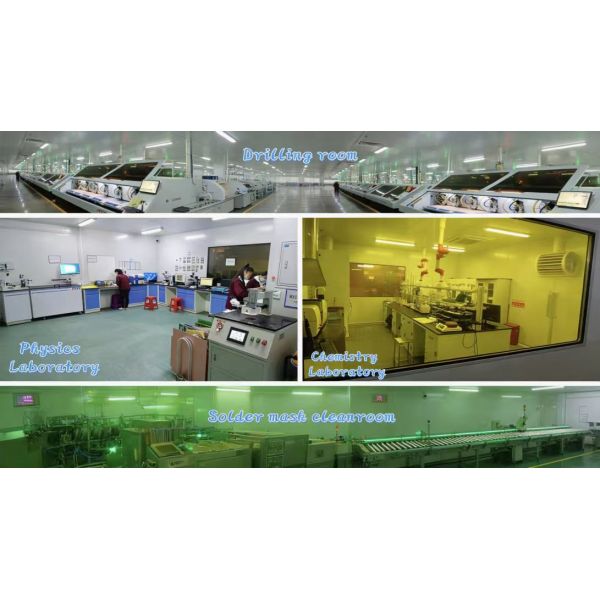
Factory showcase

PCB Quality Testing

Certificates and Honors


|
|
0.2-5.0mm Thinkness Yellow Oil Double Sided PCB Gold Finish Structure Images |